

In a world where the experience of customers determines the success of the brand, customer calls are no longer a conversation that businesses can afford to take. Each word, pause, and emotion contains strong insights which can revolutionise service quality, sales performance, and customer retention. This is where real-time speech analytics and sentiment analysis come in – transforming regular call data into useful intelligence.
What Is Real-Time Speech Analytics?
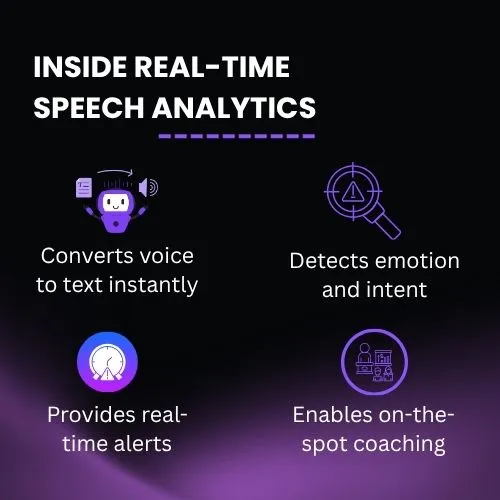
Real-time speech analytics is a sophisticated technology that is used to analyse interactions with customers in real time. It records speech patterns, keywords, or tones of emotions in live conversations so that businesses can take immediate action as opposed to the post-call review.
The system achieves this by using Natural Language Processing (NLP) and Artificial Intelligence (AI) to transcribe, interpret and classify spoken words. Provide the agent and supervisor of the call centre with real-time analytics about the level of customer satisfaction, intent, and sentiment.
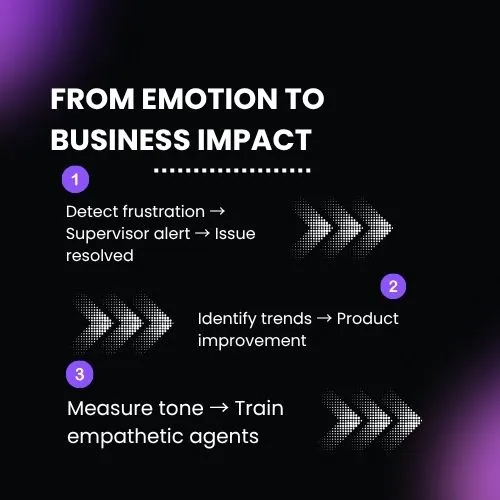
As an illustration, in case a customer sounds frustrated, a system can notify a supervisor or propose emotional responses to the agent. It will contribute to de-escalating the situation prior to it becoming a complaint.
The role of sentiment analysis in deepening the understanding of customers.
Whereas speech analytics pays attention to what is being said, sentiment analysis pays attention to how it is being said. It picks up emotional hints like anger, joy or disappointment of the customer in his/her tone, the choice of words, and the speed of speech.
This enables business organisations to categorise the interactions into positive, negative, and neutral emotions and gauge customer satisfaction in real time. Sentiment analysis may even follow the emotion changes during the conversation. Providing businesses with a dynamic response to the mood and response of the customer to various touchpoints.
Converting Call Data into Action.
The real strength of speech and sentiment analytics is that it can turn raw call information into business action. This is where organisations can use this technology to achieve real outcomes:
1. Increasing Customer Experience.
The real-time alerts allow the agents to use a different tone and language on the calls to make sure their communication is empathy-based. In urgent cases, supervisors can interfere in time, which will allow them to restore customer faith on the spot.
2. Enhancing Agent Performance.
Analytics dashboards give the feedback on the metrics of agent performance, such as tone, pace, and keyword utilisation. This data can be used by the managers to customise training programmes based on the communication style, empathy, and problem-solving.
3. Determining Product or Service Problems.
Through analysing keywords and emotional triggers on a variety of calls. Businesses can note recurring problems, like pricing issues or product malfunctions, well before things get out of proportion. This understanding enables corporations to enhance products and services in advance.
4. Fuelling Data-Informed Decision Making.
Analytics Speech analytics converts opinions into objective data. It could be modifying call scripts, optimising sales tactics or even redesigning customer experiences. All decisions are now evidence-based instead of based on conjecture.
Competitive Advantage of Real-Time Analytics.
Post-call analysis is good, and it is traditional, but it is reactive. Real-time analytics, on the other hand, allow businesses to respond in real time. It is able to identify increasing call volume associated with certain complaints. Notify management about potential PR crises, or even initiate automatic workflows, e.g., follow-up emails or issue escalation.
This responsiveness in real time can be the difference between losing a customer. And maintaining a customer in competitive industries such as telecommunications, finance or healthcare.
In addition, integrated with Customer Relationship Management (CRM) systems. Real-time speech analytics can give a 360° view of the journey of each customer. This helps the firms to personalise the interactions, anticipate future needs and generate loyalty in the long run.
Addressing Implementation Issues.
Although it has its benefits, implementation of speech analytics is not without challenges. The quality of data is fundamental to proper interpretation, and the background noise or dialect difference may affect the accuracy.
To eliminate this, business organisations need to invest in powerful AI models that are trained on various datasets. Also, the priority should be data privacy – all call recording and transcriptions should be in accordance with the regulations (including GDPR).
It is also important that the employees buy in. Agents are encouraged to consider analytics as an empowerment tool, but not a surveillance tool. The technology can be adopted to help them become receptive to it through proper communication and training, as a way to increase their professional capabilities and customer influence.
Customer Interaction Analytics Future.
With the growth of AI, accuracy and predictability of speech and sentiment analytics will also increase. The next systems will not only read emotions but also read the needs of the customers exactly before they are conveyed to them.
Consider a system that identifies when a caller is about to churn – and proffers the agent with retention offers specific to the caller. Or an analytics screen that helps forecast what product a customer would most likely purchase, based on the tone and content of previous interactions.
Such trends will change the manner in which companies do business with customers, and each conversation will be defined as a strategic opportunity.
Conclusion
In an environment when all customers want to be heard and understood, real-time speech analytics and sentiment analysis provide the ideal combination of empathy and intelligence. They do not listen; they read and react and take action.
Using these technologies, companies have the ability to transform any customer interaction into an experience that is driven by data, resulting in loyalty, stronger connections, and leading to ongoing progress.
The future of any brand is in listening to their customers but actually knowing them.