

Businesses feel the pressure of an unrealistically fast-paced modern customer service world. Also extremely expected to correct the issue effectively and efficiently, hopefully in the first contact. It is a significant move that has been incorporated as a critical customer satisfaction, loyalty and operational excellence indicator and is termed First Contact Resolution (FCR). Nonetheless, most organisations have failed to have high FCR rates. Because of the ineffective routing systems, wait time and wrongly configured Interactive Voice Response (IVR) menu.
Justification Why First Contact Resolution You Should Have.
FCR is the count of times that a customer makes an inquiry or an objection. You identify it when the first contact with an organisation resolves the issue without any repeated calls or escalation. The proportional dependence of the high FCR rate relies on:
• Customer satisfaction: The customers prefer quick, responsive customer care.
• Lower operation costs: Fewer repeated contacts will reduce costs, and each query will use minimal resources.
• Better efficiency of the agents: The agents will be in a position to attend to the new queries. Rather than addressing the queries again that were not resolved earlier.
• Strengthened brand image: Reactive corporations in resolution of problems would have reputations and faithfulness.
Go to Intelligent Call Routing and IVR.
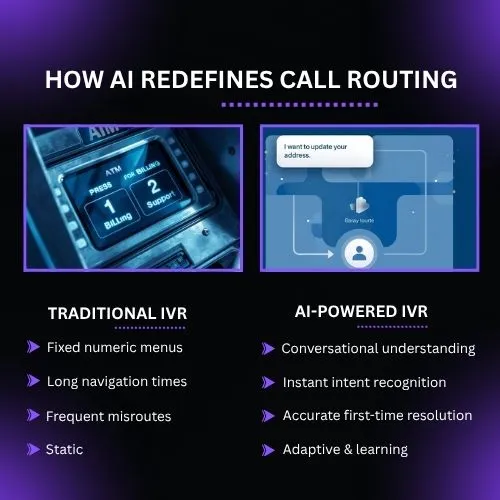
The AI-powered call routing systems and IVR systems are informed by the natural language processing (NLP), machine learning. Predictive analytics to build a smarter, dynamically charged customer experience. Rather than directing the callers to long and tedious menus and calling the customer in a department he/she does not belong to, AI deciphers the query at hand. Directs it to an agent or a robot response that best suits the query.
These technologies can be useful to FCR in the following way:
1. Smart Prelaunch Intention.
The conventional IVR is the one whereby a customer must press 1 in order to get a bill or 2 in order to get help. In their turn, AI-based IVRs enable the customers to just say what they need. E.g., when a customer says, ‘I want to update my address,’ the system will know what the customer needs. Also refer the customer to the department for updating their address or even run the same automatically where applicable.
2. Personalised Call Routing
Under AI, a company will make routing decisions based on customer data, e.g., past interaction, purchase history, sentiment analysis, etc.,. These routing decisions will be more efficient. This may be in the form of an example where a customer who has an outstanding request is making another request to the system. The system may automatically call back the customer to the same agent who served him/her in his case previously. He/she will have a higher chance of solving the case in real time.
3. Anticipatory resource allocation.
AI is not just an enhancement of routing in real time; it also learns time patterns. In accordance with the statistics of the number of calls and the nature of frequent issues and the most active hours, AI would be able to forecast the demand. And would organise the working process. This is necessary since it facilitates availability of the right agents with the right skills at the right time. This is imperative in enhancing FCR.
4. Self-service is easily accessible.
The available AI IVRs are capable of resolving several problems without the assistance of a live agent. Viewing account balances and changing or clearing a password – customers are able to do so using conversational interfaces. Self-service is not always adequate, and, in the current scenario, we can insert the AI that would facilitate the transition to a live agent to such an extent that all the context behind the case can be relayed to the customer, where he/she would not need to repeat himself/herself.
Measures of Performance: AI-Assisted Insights.
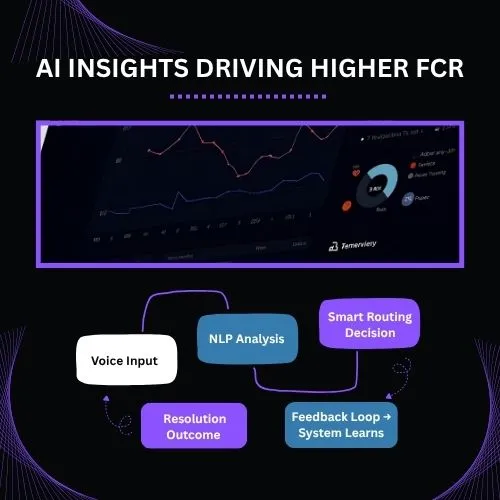
AI does not just enhance FCR – it also gives remarks on what led to the success or failure of some interactions. Through real-time analytics and feedback loops, AI could find trends, e.g., frequent traffic jams, frequent customer dissatisfactions or training requirements of an agent.
Real-World Impact
The outcome of the improvement of the AI-enhanced call routing and IVR systems is already being felt by many UK businesses. An example can be the telecommunication company whereby, after adopting intent-based routing, a subsequent firm was in a position to reduce the mean handling time by 25 per cent, the FCR by 30 per cent, and so on.
A Smart Future of FCR.
The intelligent automation and knowledge-based will be all the more applicable to retain the high levels of the First Contact Resolution as the customer expectations vary.