


Voice-based AI agents are a hot business topic at the moment when Artificial Intelligence is still gaining pace in interacting with customers. Nonetheless, it is not that easy to introduce automated call agents in the UK as one can run a bot and configure it on. Because it is a complex regulatory landscape on the matter of privacy, data protection and communications. This must be done due to the crossroad of the UK GDPR, Data Protection Act 2018, PECR and the supervision of Ofcom. These are leading to businesses remaining within the law and does not lose the trust of their customers.
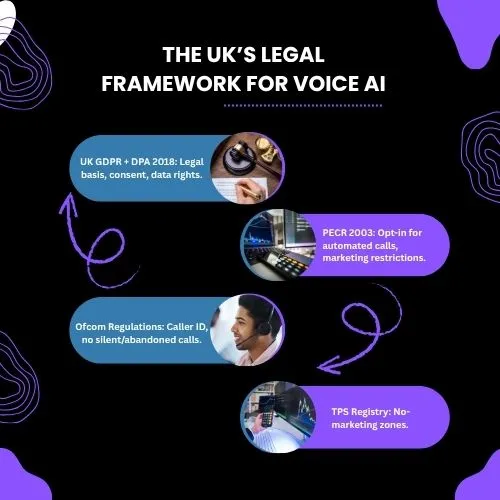
The Policy Environment: Huge Legislation in the Game.
1. UK GDPR + Data Protection Act 2018
These are the tenets of the personal data protection in the UK. Any form of processing of personal data including voice conversation recording, profiling or transcript formation must have a legal basis (e.g. consent, legitimate interest). Minimalisation of data and limitation of purpose and the rights of data subject (access, erasure, objection, etc.).
2. Privacy and Electronic Communications Regulations (PECR) 2003.
PECR regulates electronic marketing such as calling. Ban automated calling or pre-recorded voice messages to be used in marketing without a prior agreement with the recipient. Practically any AI-driven outbound call that works as marketing will need clear opt-in permission by the individual.
Telephone Preference Service (TPS) within the UK also contributes its part. When a number has been added to the TPS, any marketing call made to that number is forbidden.
3. Ofcom / Calling Regulations Automated.
Ofcom (UK communications regulator) imposes regulations of nuisance calls, caller identification and rate of abandoned calls. These rules have to be respected by any AI or automated dialing system e.g. a valid calling number must be displayed, silent calls must be avoided. The abandonment rate must be handled to acceptable levels, and the hand over has to be smooth.
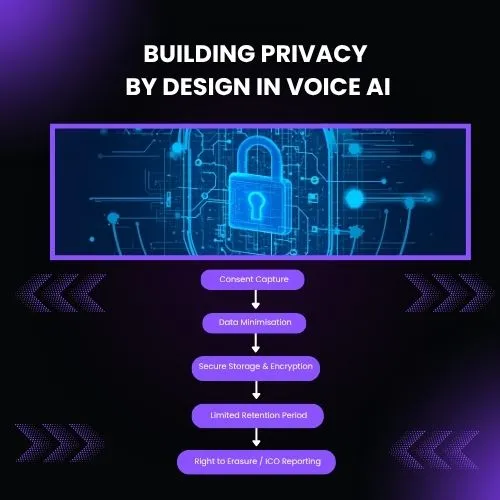
How This Implications on Voice AI in Practice.
Based on theory in practice, the key implications and compliance guardrails to businesses that design or deploy voice AI agents in the UK are the following:
1. Consent Is Crucial
When outbound marketing calls or active outreach by you are made by your AI agent. Then each person must have express opt-in permission, and no-one should have opted out (e.g. via TPS).
Your systems must maintain strong documentation of consent (who, when, how) and permit comfortably the revocation of consent.
2. Transparency & Disclosure
When initiating any interaction, the caller must be informed that he/she interacts with an AI agent. Clearly mention the name of your organisation and the reason why you make the call.
In case you make decisions automatically (such as profiling or routing), you have to provide people with information on how the decisions are made and, where applicable. Provide a point of human intervention.
3. Information Minimisation, Retention, and Security.
Record only what is required (e.g. transcript rather than raw records, where feasible), store voice data only as long as it is necessary, have encryption and access control.
Should a data breach happen (i.e. unauthorized access to any call recordings), you are obliged to report this to the Information Commissioner’s Office (ICO) as stipulated by UK GDPR.
4. Risk Analysis and Impact Evaluation.
Conduct the Data Protection Impact Assessment (DPIA) or other privacy risk analysis prior to launch to establish the harms that might be caused by using your voice AI and address them.
In case the processing is found to be high risk and the mitigating measures are inadequate, you might have to discuss it with the ICO.
5. Making Human Handover & Appeals.
When your AI system is using decisions (e.g. qualifying a lead or rejecting a request), you must offer a way to have a human go through decisions or override those decisions. This is particularly necessary where decisions may have a significant impact on people.
Conclusion
Voice AI has a lot of potential in automation of customer outreach, customer support, and sales. Its use in the UK, however, needs to be sensitive on privacy, precise communication and strict adherence. Organizations need to use AI to their advantage without falling into the trap of regulatory authorities or losing consumer trust and confidence by aligning your architecture and processes with the UK GDPR, DPA 2018, PECR and Ofcom regulations, and by treating privacy as a design principle, rather than an exception.