


The UK is a fantastic, diverse nation. A cultural tapestry of over 300 different languages, various dialects and accents which are tales of the past, migration and modern identity. However, despite this diversity, there are several technologies that are voice-based that still do not have an understanding of all. Millions of people each day are forced to undergo experiences of great frustration. Because their very speech is not delineated properly. Whether it be call centres, smart assistants or even automated banking helplines.
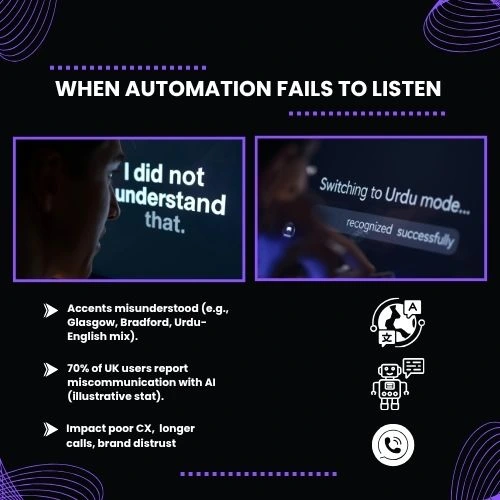
The Problem: Automation that does not understand the accent.
The systems of voice recognition of years gone by were trained on small datasets. Generally English speakers who had a limited background in a peculiar regional or socioeconomic context. This meant that it was possible for such automated systems to be confused by accents that were native to, say. Birmingham, Glasgow or Bradford or even those of the inflections of South Asian, African or Eastern European. As such, you call on your telephone, say to the person down the telephone line from your broadband provider that you want assistance with your internet. And you are greeted with the phrases:
“I am sorry, I did not understand that; could you repeat it?”
Experiences such as this are no mere irritations. They put off users and drag down the customer service. Also enforce the concept that technology is not built to fit all. To companies this will mean low customer satisfaction and thus high call times. Thus reputational risks to the brands, especially in a linguistically diverse country such as the UK.
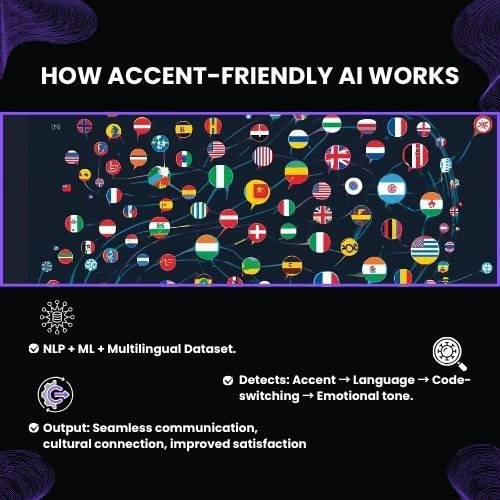
The Opportunity – Local Language Speaking AI
The new advances in natural language processing and machine learning change this. The voice automation systems of the day can understand regional accents even to the degree of multilingualism. Code switching (where speakers change languages in the middle of a sentence, which is the norm in many bilingual communities). For example, a customer may say, “Hello, I want to find out my bill for the last month. Meri payment confirm ho gayi kya?” This could be easily handled by a properly selected multilingual voice agent who fluently understands the transition between English and Urdu and reacts fluently.
Why the UK ought to be accent-conscious and automated.
The 2021 Census found that in England and Wales over 10 million inhabitants had as their first language another language than English, and of these the majority were Urdu, Polish, Punjabi, Bengali, Gujarati, and Arabic speakers. On top of this there are the local accents of Great Britain, which include local Welsh lilts and Scots brogue, and the necessity for elasticity in automation cannot be overlooked.
Healthcare, financial, retail and government services are prime examples of sectors that could combine engagement accessibility-enhancing technology. Accent-friendly voice automation can: • Be made inclusive and accessible by allowing people to socialise in their own natural tongue. • Enhance customer satisfaction through better and streamlined communication. • Cut down on call centres and see increased self-service automation. • Create differentiation through cultural sensitivity and respect. • Essentially, create trust through more listening technology. However, it is just this that currently finds customers wanting to come back.
Already on the Ground in the Real World.
Stroke ahead firms in the UK are looking at those able to handle the accented voice AI. Likewise, banks are now using multilingual IVRs (Interactive Voice Response) capable of handling dialects and languages. The healthcare profession is also enzymelessly trying out voice bots able to obtain patient information in English and South Asian dialects. Retail brands are attempting voice shopping assistants which can recognise dialect regions to give tailored recommendations.
The Future: Emotionally Intelligent and Culturally Sensitive.
The next step in this evolution is in the form of emotionally conscious, culturally adaptive voice agents. As well as understanding words, these systems will understand tone of voice, emotional intent and cultural considerations. Imagine a voice agent that can grasp the frustration in the tone of the person calling and change the way they speak to the caller to sound more understanding, or an agent that recognises cultural models of communication and speaks to the caller in the right way.
Coupled with multilingual and accent-sensitive capabilities, these emotionally intelligent systems have the ability to radically transform UK businesses’ interactions with their communities. They will not just hear; they will comprehend.
Conclusion
Diversity is one of the strongest points of the UK. Technology should start to reflect that. The human voice in multilingual accent-sensitive automated systems does not just enhance communication; it creates a sense of belonging and identification, it engenders empathy, and it closes the gap to language barriers.
In an age of automation where the voice of business now speaks, the speed at which automation technology responds cannot be the real measure of innovation; it must be its ability to listen.