

When customer experience has become the key element of brand loyalty, UK businesses are reaching a new stage: emotion-conscious voice technology. In addition to basic voice recognition and canned gestures, these new-generation artificial intelligences are able to decode the tone, mood, and emotional undertones of words and react with empathy. Emotion-sensitive voice agents are changing the way companies interact with their customers in retail, banking, and healthcare, as well as hospitality.
The Emerging Emotionally Intelligent AI.
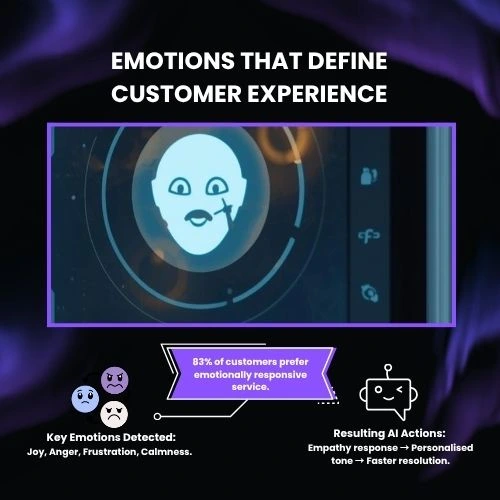
Working voice assistants, such as Alexa or Siri, are based on logic and language. They know what you say – but not what you feel. The emotionally conscious voice agents, though, operate on a higher order with the help of sophisticated speech analysis, machine learning and natural language processing (NLP). To recognise details on stress, happiness, frustration or confusion in real time.
To give an example, when a customer calls the helpline of a bank and sounds rather nervous, the system will be able to evaluate changes in the tone and modify the replies. Providing a person with the needed reassurance or sending the matter to a human operator. Emotion-aware AI is a game-changer due to this capacity to make the digital interactions more human.
The Importance of Emotion in Customer Experience.
A PwC study revealed that most buyers are willing to pay more for a great customer experience. Emotion contributes highly to the development of such experiences. Individuals do not recollect anything a brand said; they recollect the manner in which it made them feel.
Emotionally intelligent systems introduce compassion in the computer world. You can recognise a customer by their mood, and they can:
• Diffuse frustration in the course of complaint calls.
• Individualise experiences through tuning and reactions.
• Show empathy and compassion to increase pleasure.
Emotional awareness may be the defining distinction factor for UK firms that engage in businesses. Such as retail, fintech, and telecommunications, where business retention is pegged on the quality of the services.
The Technology of Emotion Recognition.
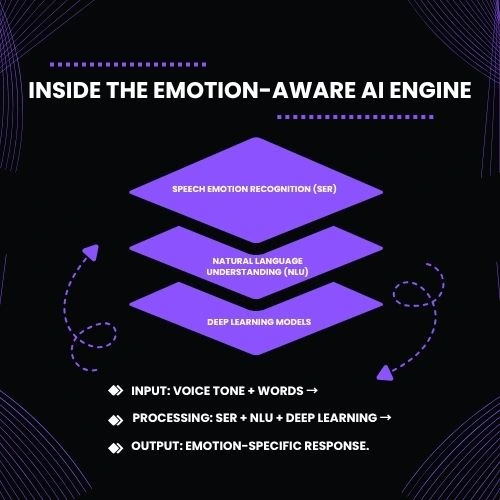
The combination of technologies is used by emotion-aware voice agents:
1. Speech Emotion Recognition (SER) examines acoustic markers such as intensity, pitch, and rhythm to determine emotional states.
2. Natural Language Understanding (NLU) – Process of understanding spoken words.
3. Deep Learning Models – It is a model that learns continuously on large amounts of emotional speech to enhance accuracy.
Other sophisticated systems even fuse voice information to facial recognition (during video calls) to form a more holistic emotional advert. But in voice-only channels, one can easily decipher emotional context with high accuracy by minor differences in tonality and tempo.
UK Applications in the Real World.
1. Customer Support/Call Centres.
Emotional AI is already in pilot use in UK call centres to assist call centre agents to respond better. The system can hint at the need to change the tone of voice to a calmer one. Or increase a call by marking emotional indicators. This enhances the performance of the agents as well as the customer satisfaction ratings.
2. Healthcare and Mental Wellbeing.
Voice-based emotion detection can assist in the NHS and private care to identify the stress or depression level of the patient during a remote consultation. In the case of mental health apps, it enables the preemptive treatment of emotional distress. This may manifest itself as early as possible instead of reactively.
3. Retail & E-commerce
Imagine a virtual shopping butler that reads excitement or reluctance in the voice of a customer and changes its tone; it will be reassuring a customer to purchase something costly and excited about a fashion discovery. This technology will help retailers to engage audiences and make conversions.
4. Financial Services
Fintech companies and banks are investigating emotionally intelligent systems to enhance their fraud detection (through nervous tones when verifying their client) and client trust (through emotionally intelligent communication when doing complex transactions).
Ethical Issues and Confidence.
Innovation comes with responsibility. UK business ventures must adhere to GDPR and other privacy regulations when processing sensitive data involved in emotion detection. Whenever you analyse emotional data, you must inform customers about it and explain how it will be used.
In establishing trust, transparency, permission and ethical design of AI will be crucial. Technology that is emotion conscious must serve to improve human relationships – not to control them.
The Case of Why UK Businesses Should Pay Attention.
Emotion-sensitive voice recognition is leaving the laboratory and being implemented in the real world at a rate much faster than anticipated. The global market of emotion AI is expected to exceed 60 billion by the year 2030, and Europe is one of the quickest developing markets, according to market forecasts.
Already there is a tangible positive effect in early adopters within the UK, where better customer satisfaction, reduced resolution periods and enhanced brand loyalty are being realised. With the increasing adoption of emotion recognition into the voice platforms of more businesses, the ones that wait will be left behind.
Final Thoughts
The voice agents that are emotionally aware are the next step in AI-based customer experience. They fill the gap between automation and empathy, and they can assist businesses not only to serve clients but also to know their customers.
In an online economy where every touch counts, the UK companies that adopt emotional intelligence in technology will not merely survive in the innovation game; they will reinvent the innovation game.