


Convenience is the most precious currency in the current digital world, where there is a lot of fast movement. Voice technology is taking over the shopping experience in order to redefine the shopping process as consumers want to shop faster, easier and more intuitively. Voice commerce, or vCommerce as it is also referred to, is altering the way the UK consumer relates to the brand and conducts purchases, all by speaking, no more than that.
Voice Commerce in the UK.
As the use of smart speakers such as Amazon Alexa, Google Assistant, and Apple Siri has increased, the UK has become one of the areas in Europe that have been the most active voice technology markets. Statista revealed that the voice assistants were used by more than 14 million individuals in the UK in 2024. A figure likely to increase sharply as the technology can become even more ingrained in day-to-day activities.
Retailers are acknowledging that voice interaction is not another channel. It is a frictionless experience that turns shopping into a conversation. Be it in the reorder of groceries, travel tickets, or utility payments, customers are enjoying the comfort of being able to complete a transaction by simply shouting, ‘Alexa, reorder my skincare essentials.’
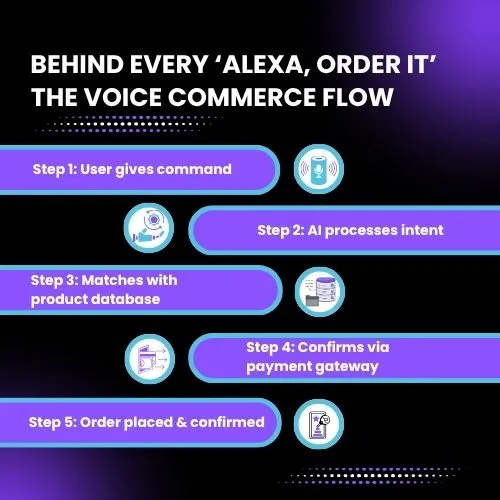
What is Voice Commerce and the Way It Works?
Voice commerce allows users to find, browse and buy products or services by voice-based commands rather than the conventional screens. Brands can provide voice-based experiences by combining voice assistants with eCommerce platforms, payment gateways, and CRM systems.
For example:
- A user can say, Hey Google, order a pepperoni pizza at Domino, and the assistant will fulfil the order based on his or her preferences.
- One might ask Alexa, ‘Where is my Amazon shipment?’ and Alexa will provide the real-time updates.
- Even local retailers will be able to use voice agents to make voice-based reservations or payments through WhatsApp or smart speakers.
These voice agents operate on natural language processing (NLP) and AI algorithms in the background to interpret the context, identify a purchase intent. And match the voice command of the user with the appropriate transactional system.
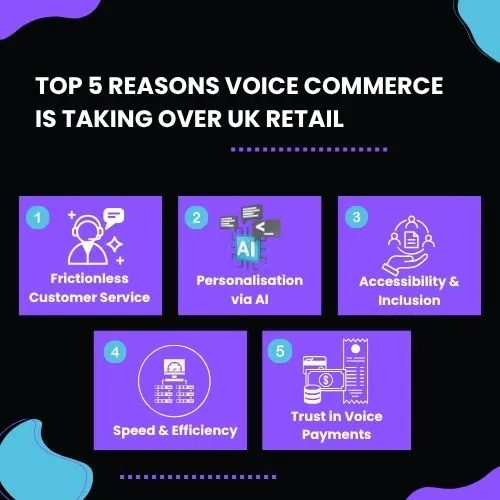
The reason behind the boom of voice commerce.
1. Frictionless Customer Service.
It is tiresome to type, tap and navigate, particularly when one has to multitask. Voice commerce is convenient, and one can simply shop at any time they are preparing, driving, or even exercising because it is hands-free.
2. Personalisation at Its Best
Voice assistants keep a record of the purchase history, preferences and routines of users, which allows hyper-personalisation of recommendations. An example is when your assistant announces to you that you are out of bean coffee. Would you like to reorder?”
3. Accessibility and Inclusiveness.
Voice-assisted shopping can eliminate digital barriers and make online shopping more inclusive to older consumers or individuals with visual impairments.
4. Speed and Efficiency
The voice-driven commands take minutes to complete what would otherwise require minutes to do via the traditional search or checkout process. This saves the customer experience significantly.
5. Confidence and Conversational Intimacy with AI Assistants.
The audience in the UK has become accustomed to AI assistants handling things such as reminding them to do certain things, building playlists, and so on. And the idea of buying things with the help of the former would be a logical next step.
Voice Payments: The Ultimate Puzzle Piece.
Secure voice payments have been emerging; this has enhanced the growth of vCommerce. Users can now make purchases safely with the help of biometric authentication like voice recognition and tokenisation. Voice-activated payment systems are being installed by leading payment providers in the UK. Such as Mastercard and PayPal, which is a critically important layer of trust.
Challenges to Overcome
Voice commerce continues to encounter obstacles:
• Security Concerns: There are the users who are more concerned over privacy and voice data collection.
• Complex Purchases: They can still be high-consideration products such as electronics or clothing.
• Poor Retailer Integration: Voice search or transactions are not yet optimised with all of the UK retailers.
These obstacles will, however, reduce at a very fast pace as AI-driven contextual understanding becomes better.
The Future of Voice Commerce in the UK.
In the future, voice commerce is going to be a typical shopping medium. Marketing departments are already moving towards voice SEO, and retailers are already developing voice-optimised websites to reach this emerging group of users. In the nearest future, consumers can make purchases with the help of voice agents and also compare prices and loyalty points and even converse with customer support.
Final Thoughts
Voice commerce is not a technological change; it is a behavioural change. The shopping habits of consumers are changing to be more about clicks and conversation, and those businesses that adopt this change will earn the loyalty of the customers in the coming years. In a digital-first economy such as the UK, speaking to a shop will soon be as natural as scrolling or swiping.