

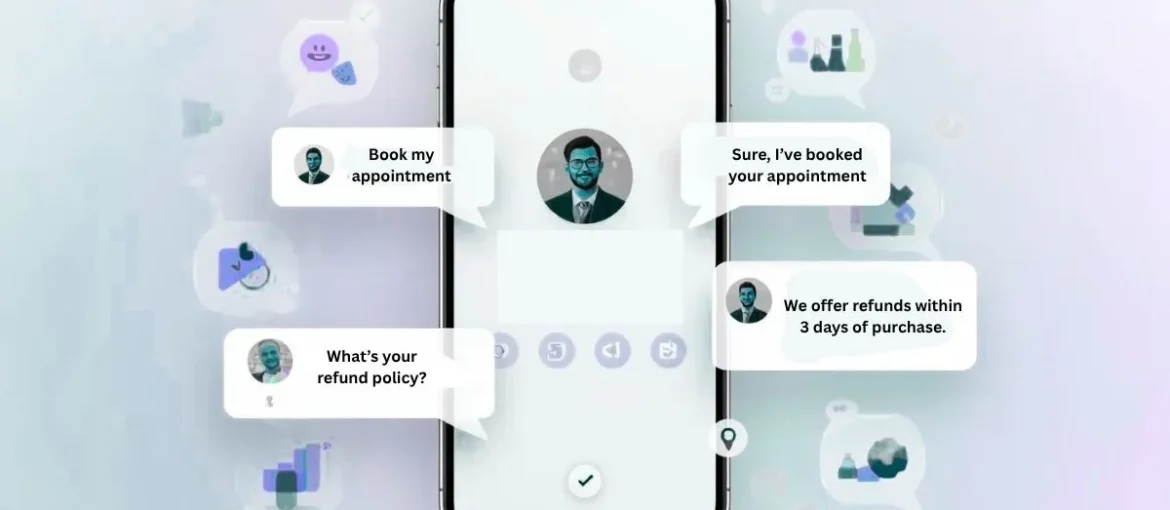
In the rapidly changing digital world, customers are ready to receive immediate answers and be able to interact without any difficulties. Holding or scrolling through endless pages of the same menu is now outdated — you can simply pick up your phone and speak to an intelligent assistant that understands, processes, and delivers results within seconds. You have just entered the voice bot age. The new frontier in self-service automation that is changing customer experiences in industries.
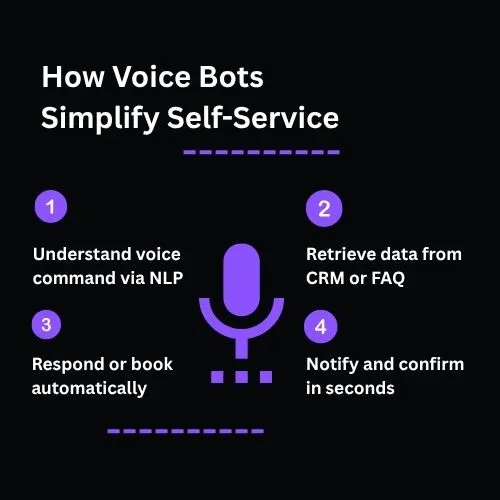
The Switch to Voice-Activated Self-Service.
In the last ten years, there has been an impressive change in customer service automation. Where we have seen simple chatbots and email responders to sophisticated voice-activated systems. In contrast to the classic touch-tone IVR systems, new voice bots also rely on the latest Natural Language Processing (NLP) and Artificial Intelligence (AI) to interpret human speech patterns, context, and intent.
It implies that the users will be able to engage in a conversational, natural manner (asking questions, making appointments or getting updates) without having to learn to fit into a fixed set of commands.
FAQs voice bots: Instant, Accurate, and Always Available.
Automation of frequently asked questions is one of the best uses of voice bots. The conventional method of businesses has employed huge proportions of their support departments to handle monotonous questions. Such as store hours, pricing, refunds, or simple troubleshooting.
Voice bots remove this bottleneck by automating this inquiry. They are able to retrieve knowledge bases, company policies or CRM information. To provide prompt and uniform responses – even when out of business hours.
As an illustration, a retail brand can use a voice bot that responds to:
• How much are your delivery fees?
• Is it a medium-sized product?
• “How can I track my order?”
Such 24/7 availability means that customers will not be made to wait in line, but human agents are relieved to concentrate on the difficult or high-value interactions.
Scheduling/Appointment Management: Efficiency in Simplicity.
Another field that voice bots are changing the game in is the management of appointments. Be it in a salon appointment, at the doctor, or in the repair shop, customers would rather talk in a natural manner than complete a form or receive a phone call.
The voice bot is able to take care of the whole system of scheduling. Not only by checking slots but also by checking the appointments and sending notifications.
For example:
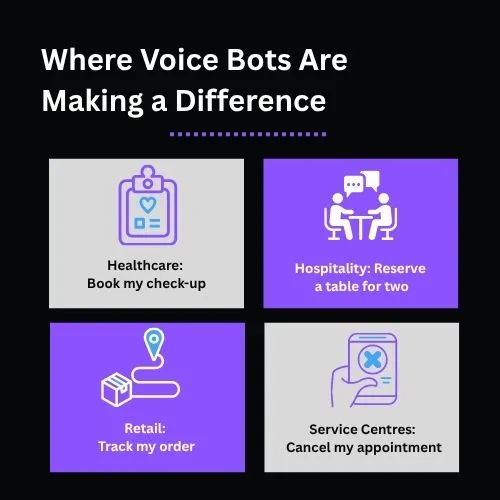
- In healthcare, the patient gets an opportunity to make a call and say, ‘Schedule my dental cleaning on next Tuesday afternoon,’. And the bot will reserve the slot, update the calendar, and send a reminder.
- In hospitality, customers can request to make a reservation for four at 8 p.m., and the bot will make the reservation automatically.
- In service-orientated businesses, customers are able to re-book or cancel appointments without the involvement of a human being.
This does not only increase customer satisfaction but also operational efficiency in that mistakes made in manual scheduling. Missed appointments are minimised.
The Technology behind the Transformation.
Voice bots are on the rise due to the advancements in machine learning and AI-based speech recognition. Google Dialogflow, Amazon Lex and Microsoft Azure Speech services are also allowing developers to develop intelligent voice systems. That learn with every interaction and are more accurate and contextually aware with time.
Furthermore, the combination with CRM systems, ERP software, and online calendars enables voice bots to have more individual and dynamic actions. Any customer posing a question such as, ‘When is my next appointment?’ will get an immediate personalised answer based on his or her account information.
This combination will turn voice assistants into powerful front desks, which will be able to process thousands of interactions at once.
Business and Customer Advantages.
For Businesses:
• Cost Efficiency: Does away with staffing of repetitive duties.
• Consistency: Assures correct and standardised answers.
• Scalability: Manages large call volumes with ease.
• Data Insights: Gathers useful conversation data to enhance services.
For Customers:
• Comfort: Find assistance everywhere.
• Rapidity: Instant responses without delay.
• Personalisation: Context-based responses to personal needs.
• Accessibility: Easier to use by users who do not like typing but talking.
Challenges & The Road Ahead
Voice bots are quickly becoming popular, but there are still problems. The accuracy can sometimes be compromised by accents, background noise and even regional dialects. Also, the primary concerns are privacy maintenance and availability of sensitive data during voice communications.
Nevertheless, with the development of AI models and the inclusion of speech recognition, these drawbacks are rapidly fading away. It can be assumed that the future of the omnichannel is when voice bots will be actively integrated into the ecosystem of chatbots, email, and human support to form a single, smart customer care system.
Decisive wrap-up: The voice-first future.
The world is becoming voice-first, where customers will want to use technology the same way they can talk to people. Those businesses that adopt this change early on receive an advantage of competition, offering quicker, friendlier and more efficient service.
Voice bots are not a trend but the new way of engaging smartly and self-servicing in answering FAQs, booking appointments, and making reservations.