


The Smartness of Customer Experience and Efficiency Integrations.
Business automation is changing, and voice technology is playing centre stage. Artificial intelligence-driven voice agents do not just respond to frequently asked questions anymore, nor do they make a phone call. Nowadays, businesses are actively integrating them into their core systems. Such as CRM platforms, booking tools, inventory software, and helpdesk solutions. Forming a smooth ecosystem that delivers a better customer experience and increases operational efficiency.
We are going to consider how voice agents are being used to transform the way modern companies work by integrating them with key business tools.
1. Voice Meets CRM: A New Horizon of Personalisation.
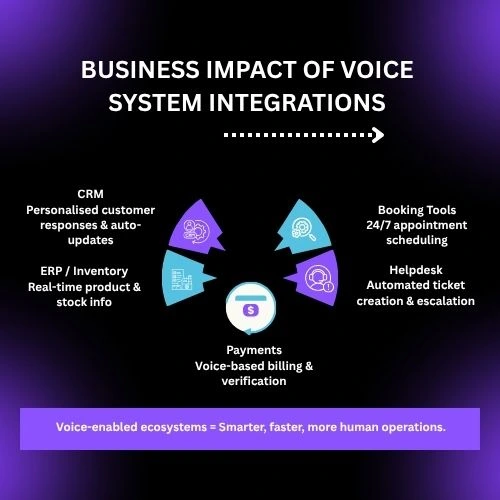
The core of any customer-focused organisation is provided by Customer Relationship Management (CRM) systems such as Salesforce, HubSpot or Zoho. The inclusion of voice agents into these CRMs opens up a different perspective of interaction that is personalised.
Suppose a repeat client has called your company. They do not have to begin with the voices because the voice agent will call them by name. Recall their past orders or service record and use it to customise the conversation.
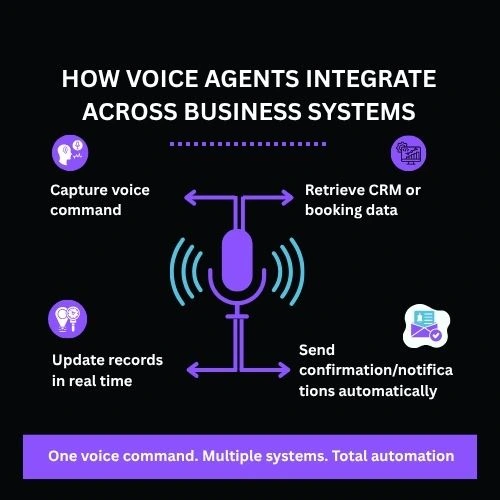
This is not a futuristic thing, but it is already becoming a reality. Voice agents are able to automatically record calls, update contact records and send follow-ups automatically in the CRM. As an example, in case a customer questions an order being made. The voice agent will be able to retrieve the information directly stored in the CRM and give real-time information.
2. More Intelligent Reservations and Appointments.
The other field where voice integration is transformative is in the booking systems. No matter what business you are operating in – a salon, a medical clinic, or a consultancy firm. It is important to plan appointments effectively.
Voice agents can support appointment booking 24/7 with the help of such tools as Calendly, Acuity Scheduling, or custom booking systems. All a client has to do is say to make a booking with Sarah next Thursday afternoon. The voice agent will make sure that the booking is valid, create the slot and offer a calendar invitation without any human intervention.
3. Business Systems – Real-Time Data Access.
Other than the CRMs and the booking tools, the actual strength of the integration is uniting voice agents to core business systems of a company, between the ERP software and payment gateways, inventory and logistics tools.
For example:
- A voice assistant retailer is able to notify customers on the availability of products by retrieving live information through an inventory management system.
- A voice-based logistics bot will be able to inform clients about the status of shipping by connecting to a shipment tracking API.
- A voice agent that is finance-orientated is capable of drawing real-time account data or invoice data related to a billing system.
4. Automation of customer care processes.
Consecutively, adding voice agents to ticketing and helpdesk services like Zendesk, Freshdesk, or ServiceNow can help be a game changer to customer service teams.
A voice agent will be able not only to create new support tickets but also to access the old ones. Change their status, or escalate them according to the previously established guidelines. This integration allows the organisation to have actual 24/7 customer support. Even when human agents are offline, the customers will still be able to report their problems, receive updates, or have the option of requesting a call back.
5. The Advantages: Making Experience in Efficiency.
These integrations are extremely impactful together. Businesses experience:
• Decreased operation expenses because of automation of monotonous work.
• Better efficiency in information processing and reporting.
• Regular customer experiences, time and channel.
• Reduced response times, which result in increased satisfaction and retention.
More to the point, it makes the company a tech-savvy, customer-orientated brand, which is becoming one of the major differentiators in the digital-savvy world.
6. The Road Ahead
The integration is going to become even less noticeable as AI and voice technology are being developed. As APIs continue to become more standardised and platforms more open, voice agents will soon be capable of communicating between multiple systems at the same time. Real-time decision-making and predictive interactions will become a reality.
In the case of UK businesses, particularly SMEs, an early adoption of these integrations enables the group to enjoy a competitive advantage. It is not merely about automation of operations and tasks; it is about developing smarter and more human-like interactions that enhance any customer relationship.
In Summary:
Voice agents are not a mere upgrade to business systems but a transformation of CRMs, booking systems, and others. Using voice, data and process automation as the linkage of the dots, businesses are able to offer quicker, more personalised and efficient service to the customer, establishing a new level of smart customer interaction.