


AI voice agents are transforming how businesses interact with customers, conduct operations, and reduce costs in today’s fast-paced digital economy. These smart systems are assisting UK organisations in managing customer enquiries, as well as automating order processing and appointment booking. Nonetheless, the effects of the AI voice agents vary greatly between small and medium-sized businesses (SMBs) and large enterprises, especially cost savings and return on investment (ROI).
We shall discuss the way such benefits unfold in both types of businesses. And why AI voice technology has emerged as a smart investment to organisations of any scale.
The Rising Argument in support of AI Voice Agents.
AI-powered voice agents, including virtual receptionists and conversational bots, use advanced speech recognition, natural language processing (NLP), and machine learning (ML) technologies as their foundation. They are able to comprehend customer intent. Have natural conversations and do things like order placement, FAQs or escalate a call to human agent when necessary.
As voice search, smart speakers, and customer support without contact are becoming increasingly popular, UK businesses are implementing AI voice solutions to streamline the communication process and reduce costs.
In the case of UK SMBs: Affordability Meets Agility.
In the case of small and medium-sized businesses, the money used should provide a quantifiable benefit. The AI voice agents provide the means of competing with the bigger players, without the need of spending a lot of money on human resources.
1. Automation Savings on Cost.
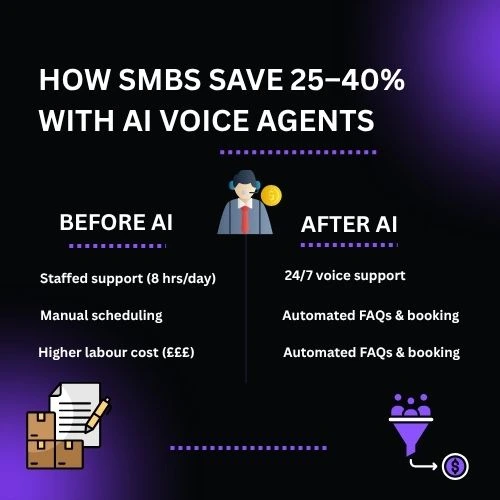
SMBs tend to work with lean teams. Examples of routine jobs that can be performed by AI voice agents include:
- Answering frequently asked questions (pricing, delivery times, bookings)
- Capturing leads after business hours
- Managing appointment bookings and confirming orders
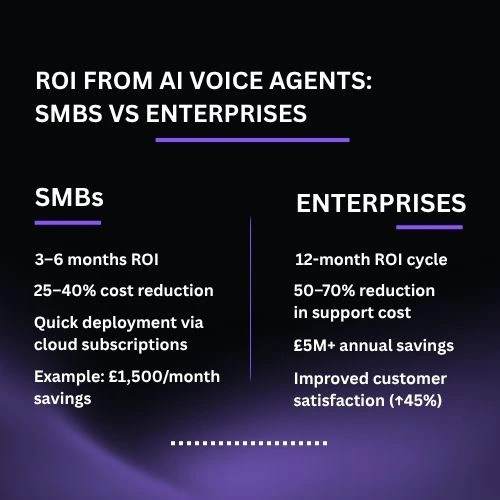
By automating these interactions, SMBs save 25–40% in staffing costs while ensuring 24/7 customer availability — something many could not achieve before.
2. Quick pay off with Subscription Models.
The current AI voice platforms are mainly cloud-based and are unlimited by paying on a contractual basis or in tiers. This enables SMBs to start small and expand as they mature and realizes ROI in 3-6 months on average. Because businesses don’t need to install heavy infrastructure or on-premise servers, they keep implementation costs to a minimum.
3. Customer Experiences as a Differentiator.
An active AI voice agent will be more responsive, enhance retention and satisfaction. In a competitive market where customer loyalty is weak, the speed and responsiveness of the business can make or break a business relation.
Example:
One of the boutique retailers in Manchester added an AI voice agent to help after hours. In three months customer satisfaction had increased by 30 and the business had saved an estimated 1500 per month in terms of staffing costs.
In the case of Large Enterprises: Scalability and ROI based on data.
Affordability is appreciated by SMBs, whereas the large enterprises are interested in scalability, efficiency in operations, and actionable insights. To them, AI voice agents are not only cost-saving, but also about performance and large-scale decision-making.
1. Decreased Operational Overheads.
Big organisations that have large contact centres incur their millions of dollars in customer support every year. These companies are able to save 50-70 percent of the operational costs by using AI voice agents to service high volume and repetitive call volumes.
2. Data-based Business Intelligence.
Voice agents do not respond to inquiries only, they gather and process information on their customer interactions. It assists enterprises in determining the areas of pain, predicting demand, and making services smarter with the help of AI-driven analytics. This data intelligence generates compounding ROI over time in both terms of personalisation and retention of customers.
3. Enhanced Human Efficiency
Human agents do not replace AI voice systems but, rather, collaborate. They are able to manage low-complexity tasks thus releasing the employees to concentrate on strategic or emotional contacts, improving productivity and morale.
Example:
One prime UK telecom company has automated its voice systems at contact centres cutting its call wait time by 60 percent and saved it about £5 million annually in support expenses, and the customer satisfaction ratings improved by 45.
The Voice-Driven Future of Efficiency.
The UK voice-first adoption is rapidly increasing, whether it is a small retailer or a national enterprise. The more contextual and conversational AI models are, the more ROI they will be able to deliver.
To the SMBs, voice agents are evening the playing field – delivering enterprise quality service at a fraction of the price. In the case of large companies, they are leading the digital transformation and open up deep operational intelligence.
Finally, it is not only about saving money but also about future-proofing your company with smarter, faster, and more human-centred customer interaction when investing in AI voice agents.